I Just Dusted Why Is So Dusty Again
How to Become Rid of Dust
Updated: Mar. 25, 2022
Keep your family safe from allergens—and from an cruddy grey film covering everything
Does it seem similar you're cleaning a flick of dust from every horizontal surface in your house every other day? You'll never have to terminate dusting completely, simply here's everything you need to know about how to go on excessive dust from building upward so apace and flying into the air.
You might also like: TBD
Household dust
Although you tin beat back the general household dust invasion, dust volition never go away. Wipe it up i week and by the next, a fine grayness film has settled on the film frames and mantel, and dust bunnies are scurrying effectually under the bed. No one yet has found the magic that'll make dust disappear, especially airborne dust. Hardware improvements such as vacuums with better filtration and whole-house air cleaners tin make the job a bit easier, merely dusting is still a weekly chore. And frankly, nosotros don't have any revolutionary ideas either. The bones solution is pretty much the same as grandma taught—clean, clean, clean.
However, if you target the primal places where dust collects and bargain with it earlier information technology goes airborne, yous tin at least put a damper on dust. In this article, we'll tell you where dust originates and where it builds up, so y'all tin focus your cleaning efforts on those spots.
First—what is dust?
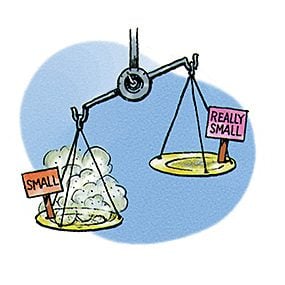
Fig. A: Modest and really pocket-sized
Pocket-size dust, larger than x microns, makes upwardly more than 90 percent of the weight of mutual household dust. Really minor dust, less than 10 microns (invisible), doesn't counterbalance much, but includes 99 percent of all grit particles.
For practical purposes, household grit fits into two categories: small stuff and really small stuff (Fig. A).
The pocket-sized stuff is the stuff that bugs y'all. It's that gray fluff that y'all run across piled up in corners, on bookshelves, and under the couch. The vast bulk of it, more than than 90 percent in nigh homes, is equanimous of only two materials, dead skin flakes and material fibers. The human body continuously sheds skin, dramatically when you accept a sunburn, yet almost constantly in the class of tiny particles. The material fibers are also modest, the same lint that you collect on the dryer screen. These particles range in size from 10 to 300 microns (one micron equals 1/1000th of a millimeter). If you have sharp eyes, you lot can just barely see a 20-micron textile filament floating in a shaft of sunlight that's streaming through the window. In comparison, the typical hair caught in your hairbrush is near 100 microns thick.
Other minor grit contributors range from man and pet pilus to soil particles, pollen, mildew spores, grit mites and other pocket-sized sources. The dust in some homes besides contains droppings from localized concentrations of cockroaches, termites, ants or other insects. (My home, with its never-ending do-it-yourself projects, has a college than normal concentration of drywall dust and sawdust!)
You tin can't meet the really small stuff, particles smaller than 10 microns, unless they collect in high concentrations. So fifty-fifty though your dwelling contains millions of these particles (they brand upwardly 99 percentage of all dust particles), they're so small-scale that they won't contribute much to the visible dust invasion.
Just really small dust can affect your health. Debris from dust mites and insects, cat and other animal dander and smaller plant spores and pollen often crusade allergies. Paint pigments, including the lead oxide used in many paints earlier 1978, also fall into this really small category too. Atomic number 82 grit is the principal cause of lead poisoning in children.
If you have a grit-related health problem, don't try expensive home remedies until yous've consulted a physician. Dust control strategies for really small particles are difficult and can be costly if you have to replace carpet with a dissimilar floor covering or buy a special vacuum cleaner. Your physician will help you discover the particular offender then you lot tin can target your command strategies, rather than assault all types of dust. We'll mention some strategies for dealing with allergy-causing particles below, but not in detail.
Y'all can't stop major grit sources
The major components of dust fall off man beings and fabrics such every bit habiliment, furniture, drapes and carpets. Since you're not likely to banish the kids and your spouse to the garage or live a life complimentary of fabric, you tin't cease the main grit-producers at their sources. Rather, you have to use adept housecleaning techniques to attack grit where information technology builds upwardly and spreads.
Better housecleaning strategy
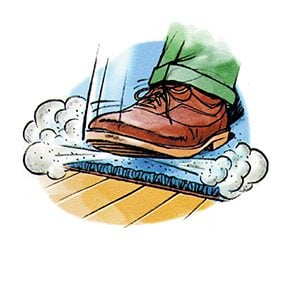
Fig. B: Vacuum carpets and shake out rugs weekly
Carpets and rugs agree a lot of dust and release it into the air when you footstep on them.
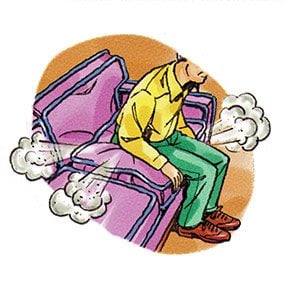
Fig. C: Vacuum article of furniture cushions and pillows
Cushions and pillows capture dust and launch information technology into the air when you sit on them.

Fig. D: Vacuum closets
Clothes closets collect a lot of material filaments and skin flakes, particularly when clutter makes vacuuming difficult.
Here are the basics: Vacuum carpets and milkshake out rugs weekly. Wall-to-wall carpet is a world-class grit-collector, and it launches particles dorsum into the air every time you lot walk beyond it (Fig. B). It's virtually impossible to make clean. Vacuuming helps, but it's like trying to suck up all the leaves from a forest. It'south easier to clean expanse rugs, because you can shake or beat them exterior or periodically send them to the cleaners. Frequent vacuuming of busy pathways won't eliminate dust, but it'll cut down the volume. And information technology will reduce the sand particles that abrade the carpeting fibers and cause them to break down. Regularly vacuum furniture cushions and pillows. Like rug, they create, collect and spew dust into the air whenever y'all sit downwards on them.
Clean bedrooms weekly, since you lot probably spend more than fourth dimension at that place than in any other room in the house. Skin flakes especially collect in the bedding, and bedding and clothing contribute fabric dust too. Regular laundering will help keep the dust down. Alert: If you suffer from allergies, bedrooms rank at the summit of the listing for dust command.
They're easy to ignore, so dress closets collect dust too. Wearable steadily sheds filaments, and every time yous open and shut the door and pull out clothing and shoes, air turbulence launches that dust into the air. Grit particles piece of work their way downwards, and so a closet floor that's complimentary of shoes and other clutter makes for quick, more effective vacuuming.
We oasis't mentioned the well-nigh obvious dust collection spots—for example, under beds and article of furniture, and behind the stove and refrigerator. It'southward true that dust settles in these areas out of sight, but one time it's settled, it commonly sits there undisturbed. Although it pays to make clean those areas periodically, they won't contribute much visible grit to active living areas of your dwelling. Clean them regularly, however, if you accept allergies, considering dust mites can thrive at that place.
End secondary dust sources
You probably blame the kids, but everyone constantly tracks in dirt from the outdoors. About drops off inside xv ft. of an entry door, so a rug only inside the door and a mat outside will collect most dirt right there at the entry.
Hair and other dust from dogs, cats and birds will spread throughout a firm. No command strategy works well. If you lot have allergies, you might take to detect a new habitation for your pets.
Dust mites live in virtually every home, because they like a warm, boiling environment with lots of skin flakes to eat. They'd be disgusting if they weren't then tiny, an almost invisible speck 250 microns in size. They sometimes proliferate in bedding and other moist areas and contribute their outer shells and other debris to the general grit level. In most cases they aren't a trouble and are hands controlled past laundering bedding and vacuuming regularly.
Notwithstanding, dust mites oftentimes cause allergies. If a physician determines that yous have a dust mite allergy, simple control methods include laundering bedding in 130-degree water and maintaining a relative humidity level below 60 percent through air conditioning or dehumidification. The dust mites will before long dry up and dice. For persistent problems, your physician volition directly you to specialized (and more expensive) dust mite control methods, like special bedding, carpet removal, and higher efficiency vacuums. (1 mail-society source for these products is Allergy Control Products, Inc. Call 800-255-3749—800-255-ALLERGY—for a free catalog.)
Mold and mildew release thousands of tiny spores that contribute to localized grit, create bad odors and sometimes cause allergic reactions. Mold and mildew are microscopic fungi that live in huge colonies in clammy areas. The colonies look like dark smudges and can be found in corners, on the grout in bathroom tile and particularly nether carpeting in damp areas similar basements. Control mildew and mold by eliminating the moisture supply past such means as dehumidification, exhaust fans in bathrooms, ameliorate foundation drainage, and sealing concrete floors or removing rug. You tin can kill existing mold and mildew past washing the surface area with a mixture of one part liquid bleach to x parts water (wear plastic gloves and centre protection).
Finally, keep an eye out for black soot stains on walls, the TV screen or the carpet under doors. They signal a unsafe combustion leakage from kerosene heaters, the water heater, furnace or fireplace.
Basic dust-control tools
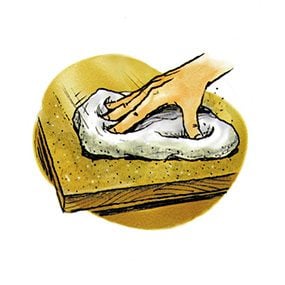
Dusting
A damp fabric is all y'all need to pick up dust from hard, smooth surfaces.

Vacuuming
Utilise a vacuum with a beater bar for carpet and rugs and a hose for corners, fabrics and furniture.
How to Become Rid of Dust on Hard Surfaces
Dusting
A damp material is all you need to pick up dust from hard, smooth surfaces. (Not wet, considering water left behind carries clay and can ruin the finish on fine article of furniture.) The grit sticks to the fabric rather than flight around and spreading. Mops and cloths and lamb's wool dusters with electrostatic charges also work well.
Dust loves clutter. Ataxia demoralizes fifty-fifty a veteran housecleaner by increasing the fourth dimension and effort involved. Store stuff y'all're not using, and enclose knickknacks in showcases. Keep stuff off the flooring.
How to Get Rid of Dust in Carpeting and Furniture
Vacuuming
Use a vacuum with a beater bar for carpeting and rugs and a hose for corners, fabrics and article of furniture. Dispensable paper bags filter better than cloth numberless, usually down to about 10 microns. They'll get most visible dust, assuming the vacuum doesn't accept leaky hoses or a loose drove system that releases dust before it gets into the purse.
On the other hand, standard vacuums are one of the worst tools for allergy sufferers, considering they spew actually pocket-size particles out in a huge airborne cloud through the walls of the bag. You can now buy tighter numberless that filter particles down to effectually 1 micron and vacuums with secondary filters that collect particles down to around .3 microns. Tighter numberless mean more resistance and lower suction, so about vacuums with secondary filters accept better motors and cost effectually $200 and upwardly. Such a vacuum is a good investment for anyone who suffers from household dust allergies.
Installing a central vacuum arrangement is likewise a good investment (assuming y'all know that household dust is causing a health problem). You can mountain the motor and collection bag in the basement or garage, and so that in one case sucked up, fifty-fifty the actually small particles stay out of the room. And the motors are usually powerful plenty to utilise a high-efficiency filtration bag. The downside is the price, $500 to over $1,000, plus installation.
How to Become Rid of Dust Floating in the Air
Air Filters
Pleated and higher efficiency furnace and air filters continued to a forced-air heating and cooling arrangement take hold of a portion of airborne dust (see choosing furnace filters for more than information ). They can reduce the dusting task, merely you must clean or modify the filter regularly.
Required Tools for this Projection
Have the necessary tools for this DIY projection lined upwards before you start—you'll save fourth dimension and frustration.
Originally Published: January 04, 2019
Source: https://www.familyhandyman.com/project/how-to-get-rid-of-dust/
0 Response to "I Just Dusted Why Is So Dusty Again"
Postar um comentário